|
The Daily Heller: Hail Anchovius Caesar, the Greatest Romaine of All by Steven Heller Posted March 22, 2022
There’s more than one way to hail a Caesar or roast a pig. Author, editor and comics artist Sarah Boxer has broken codes and recast couplets, exposing the great William Shakespeare to the slings and arrows of outrageous fortune. As we emerge from this winter of our discontent, her recent reinterpretations of Shakespeare’s most famous tragedies, Hamlet and Julius Ceasar, provide ample raw material for a comic feast punctuated by the Bard’s iconic wordplay. These books, Hamlet: Prince of Pigs and Anchovius Caesar (Bunncoco Press/[email protected]), are not just for or by the seasoned punster. Boxer, who is also author of In the Floyd Archives: A Psycho-Beastiary, a series of cartoon case histories of all things Freudian and Mother May I?: A Post Freudian Folly, is a master of what Publisher’s Weekly calls “charming and quirkily resonant images and ideas.” I asked Boxer to explain her motivations for cooking up such a feast for ear and eye. |
|
I love your introduction to both Hamlet and Anchovius Caesar. Of course you made everyone into animals. It’s as natural as a ham on rye at Katz’s Deli. But how long did you deliberate with yourself before investing a piglet with Shakespeare?
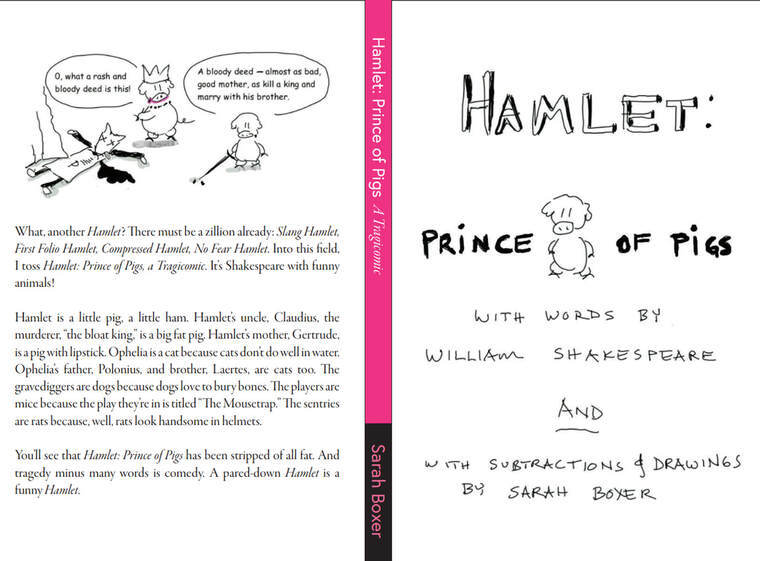
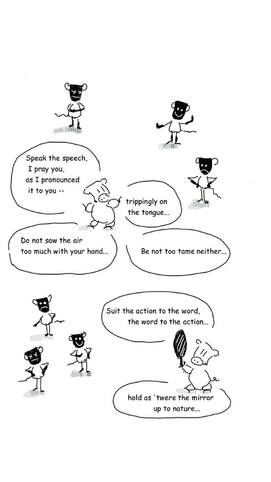
Puns have always been my favorite part of Shakespeare’s plays. Hamlet has always been my favorite Shakespeare tragedy. Put them together and what do you get? Hamlet: Prince of Pigs! But seriously, Hamlet: Prince of Pigs began with a pig in search of a part. In the 1980s, I drew a little booklet of “The Three Little Pigs” story and it dawned on me: Hey, I can draw pigs! (I already knew I couldn’t draw humans.) The publication of Art Spiegelman’s Maus gave me the strength and courage I needed to give up on humans altogether. And I was off to the races.
I drew anxious bunnies, paranoid wolves, obsessive-compulsive rats and depressed sheepskins as part of my first comic, In the Floyd Archives: A Psycho-Bestiary (Pantheon, 2001), which was based on Freud’s case histories. I did not find a part for a pig, though, until I drew my second psychoanalytic comic, Mother May I? A Post-Floydian Folly (IP Books, 2019). In that book, there’s an anxious piglet, Squiggle Piggle, who expresses himself through his squiggly tail. (He’s an homage to the child psychoanalyst D.W. Winnicott, the inventor of the Squiggle Game.)
I can’t remember exactly when I thought I was up to the task of tackling Shakespeare’s tragedies with funny animals. But once the idea popped into my head, there was no question that Hamlet would be a piglet. It’s right there in the title! In the name Hamlet, you can hear Ham-let, little ham. And, as it turned out, the pig pun fit! In Shakespeare’s day, if you wanted to make fun of royalty on stage, you’d have them wear a pig mask.
In the wonderful world of metamorphosis and anthropomorphism, there are some guidelines. What rules did you establish for continuity’s sake once you decided on the pig as your star thespian?
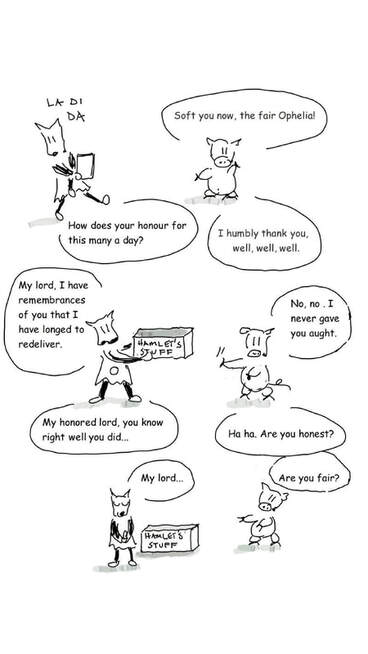
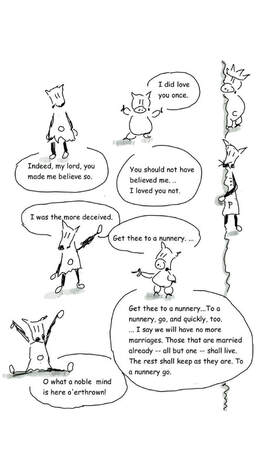
Each of my Tragic-Comics has its own rules. Once I decided that Hamlet was a pig, my next big decision was what to do with Hamlet’s family, with his dead and ghostly father, with his evil murdering uncle, Claudius, and with Hamlet’s mother, Gertrude, who marries her husband’s killer. I decided to follow a one-family, one-species rule. (I have always had trouble figuring out the family groups in Shakespeare’s plays, so I think the one-species rule is a really nice help for readers.) Thus Hamlet’s uncle, Claudius, the one who killed Hamlet’s father, would be a big fat hog, or as Shakespeare put it, “the bloat king.” His mother, Gertrude, who married her dead husband’s murderer, would also be a pig, but a pig with lipstick. For Ophelia’s family, I figured that since she dies in water, she’d be some kind of cat. Thus Polonius, Ophelia’s father, is a pompous cat, and her brother, Laertes, is an irascible cat. Those are the two main family groups. I next ruled that each profession would be one species. The gravediggers would be dogs because dogs are excellent diggers. The guards would be mice because mice look really nice in helmets. Rosencrantz and Guildenstern are weasels because they are, you know, weasely.
Puns have always been my favorite part of Shakespeare’s plays. Hamlet has always been my favorite Shakespeare tragedy. Put them together and what do you get? Hamlet: Prince of Pigs! But seriously, Hamlet: Prince of Pigs began with a pig in search of a part. In the 1980s, I drew a little booklet of “The Three Little Pigs” story and it dawned on me: Hey, I can draw pigs! (I already knew I couldn’t draw humans.) The publication of Art Spiegelman’s Maus gave me the strength and courage I needed to give up on humans altogether. And I was off to the races.
I drew anxious bunnies, paranoid wolves, obsessive-compulsive rats and depressed sheepskins as part of my first comic, In the Floyd Archives: A Psycho-Bestiary (Pantheon, 2001), which was based on Freud’s case histories. I did not find a part for a pig, though, until I drew my second psychoanalytic comic, Mother May I? A Post-Floydian Folly (IP Books, 2019). In that book, there’s an anxious piglet, Squiggle Piggle, who expresses himself through his squiggly tail. (He’s an homage to the child psychoanalyst D.W. Winnicott, the inventor of the Squiggle Game.)
I can’t remember exactly when I thought I was up to the task of tackling Shakespeare’s tragedies with funny animals. But once the idea popped into my head, there was no question that Hamlet would be a piglet. It’s right there in the title! In the name Hamlet, you can hear Ham-let, little ham. And, as it turned out, the pig pun fit! In Shakespeare’s day, if you wanted to make fun of royalty on stage, you’d have them wear a pig mask.
In the wonderful world of metamorphosis and anthropomorphism, there are some guidelines. What rules did you establish for continuity’s sake once you decided on the pig as your star thespian?
Each of my Tragic-Comics has its own rules. Once I decided that Hamlet was a pig, my next big decision was what to do with Hamlet’s family, with his dead and ghostly father, with his evil murdering uncle, Claudius, and with Hamlet’s mother, Gertrude, who marries her husband’s killer. I decided to follow a one-family, one-species rule. (I have always had trouble figuring out the family groups in Shakespeare’s plays, so I think the one-species rule is a really nice help for readers.) Thus Hamlet’s uncle, Claudius, the one who killed Hamlet’s father, would be a big fat hog, or as Shakespeare put it, “the bloat king.” His mother, Gertrude, who married her dead husband’s murderer, would also be a pig, but a pig with lipstick. For Ophelia’s family, I figured that since she dies in water, she’d be some kind of cat. Thus Polonius, Ophelia’s father, is a pompous cat, and her brother, Laertes, is an irascible cat. Those are the two main family groups. I next ruled that each profession would be one species. The gravediggers would be dogs because dogs are excellent diggers. The guards would be mice because mice look really nice in helmets. Rosencrantz and Guildenstern are weasels because they are, you know, weasely.
|
|
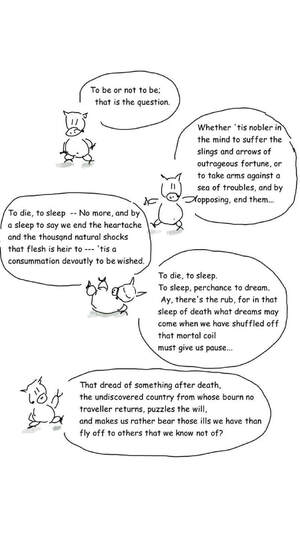
Was this an experiment without a predicted outcome, or did you know what the consequence of making Hamlet into a swine would be once you entered this world?
I only learned how appropriate it was to turn Hamlet into a pig after I started doing it. From reading Stephen Greenblatt’s great book Will in the World: How Shakespeare Became Shakespeare, I learned that in 16th-century England, the “swine-snouted king” was a stock theater figure. Nick Bottom’s ass-mask in “A Midsummer Night’s Dream,” for instance, “strikingly recalls the swine’s snout placed on the face of the king.”
You clearly know your Shakespeare. Are you fond of him as a playwright or as an infinite source of puns?
Of course, I love both! I never get tired of seeing Hamlet or Caesar or Lear on stage. And I’ve been struck many times by the uncanny similarities between plays and comics. Both use gestures and words to get across their meaning. Both like to refer to their own medium—plays to plays and comics to comics. (Remember the play within the play?) Both have abrupt breaks between scenes. And in both, almost all the words are dialogue, with practically no narration. These two arts, seemingly separated at birth, are made for each other. But I suppose what makes me feel most fuzzy and warm about Shakespeare are the puns. I love wordplay. I love making up fake etymologies for words.
I only learned how appropriate it was to turn Hamlet into a pig after I started doing it. From reading Stephen Greenblatt’s great book Will in the World: How Shakespeare Became Shakespeare, I learned that in 16th-century England, the “swine-snouted king” was a stock theater figure. Nick Bottom’s ass-mask in “A Midsummer Night’s Dream,” for instance, “strikingly recalls the swine’s snout placed on the face of the king.”
You clearly know your Shakespeare. Are you fond of him as a playwright or as an infinite source of puns?
Of course, I love both! I never get tired of seeing Hamlet or Caesar or Lear on stage. And I’ve been struck many times by the uncanny similarities between plays and comics. Both use gestures and words to get across their meaning. Both like to refer to their own medium—plays to plays and comics to comics. (Remember the play within the play?) Both have abrupt breaks between scenes. And in both, almost all the words are dialogue, with practically no narration. These two arts, seemingly separated at birth, are made for each other. But I suppose what makes me feel most fuzzy and warm about Shakespeare are the puns. I love wordplay. I love making up fake etymologies for words.
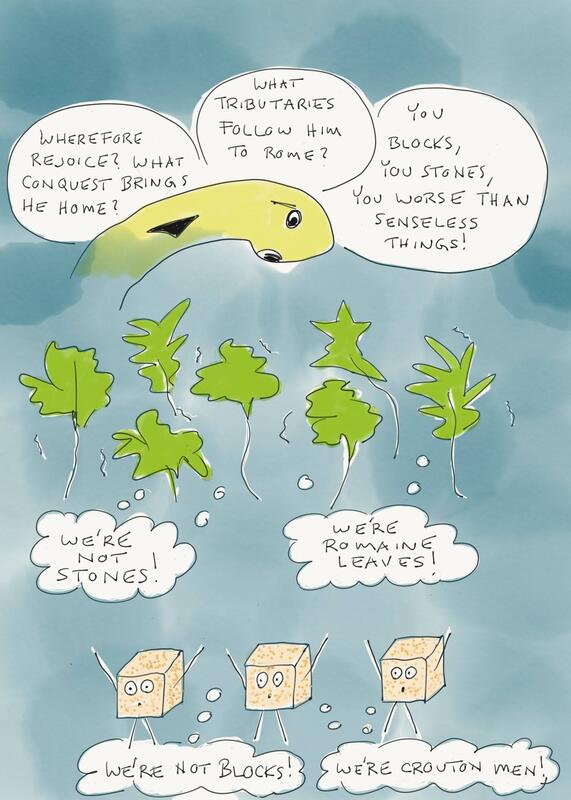
Punwise, you’ve done well with Hamlet and the variations thereon, but you outdid yourself with Anchovius Caesar. What was your process? Did you just allow the pearls to roll off your spine? Or did you have to stretch to cast the right characters? Mock Anchovy, indeed!
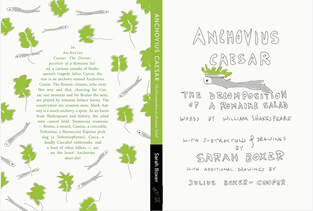
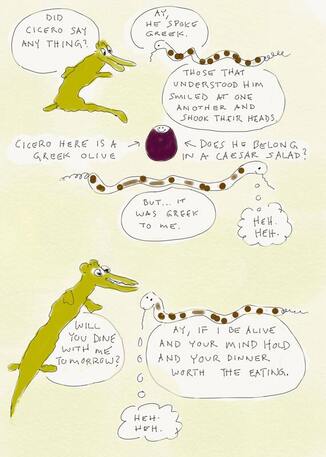
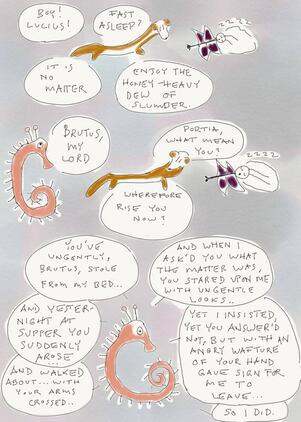
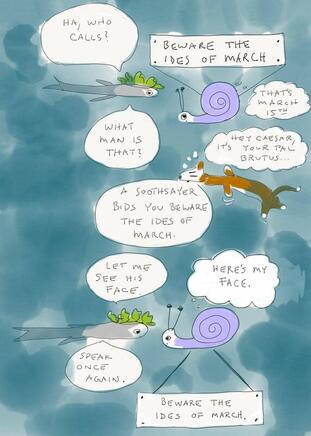
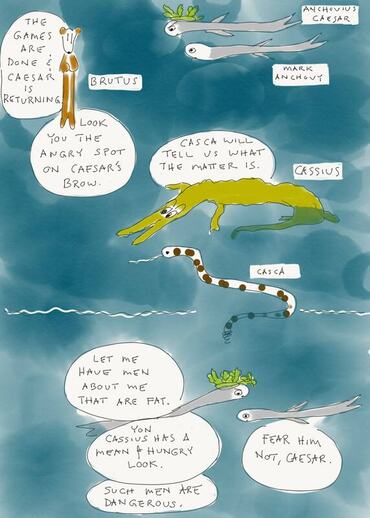
I began with the title role, with Caesar himself, the great kahuna. Because the name Caesar conjured up for me a Caesar salad, and because there’s just one animal in a classic Caesar salad, I knew that Caesar would have to be an anchovy. Anchovius Caesar! The Roman citizens, who sway this way and that, cheering for Caesar one moment and Brutus the next, would be played by romaine leaves. The countrymen would be crouton-men. It made perfect sense to me that Cicero, the one Greek guy in the play, would be a Kalamata olive, whose presence in a Caesar salad is often questioned. (Do they belong or not?) And Mark Antony? Obviously, he’s a mock anchovy, also known as a sprat. One good pun deserves another! I hit a snag, though, when I realized I was all out of Caesar salad ingredients! What would I do? I decided to hold some tryouts. That is, I tested the aspiring actors, various cartoon characters—on paper, of course—for their adaptability, cuteness and punning potential. Then I created my first rule: All characters would have to be comfortable underwater, because that, after all, is where Anchovius Caesar lives and dies. Here were my casting choices. Calpurnia, Caesar’s wife, would be a sea cow, a manatee. (Cowpurnia!) And what of Portia, Brutus’ mate? The Porsche logo—a coat of arms with a horse upon it—saved the day. She’s a seahorse, of course! Flavius and Marullus, the slithering scolds at the start of the play, would be moray eels. Artemidorus, the diviner who tries to warn Caesar about the plot to kill him, would be a dream-fish. And Cinna the poet? A cinnamon clownfish, naturally. While all the characters loyal to Anchovius Caesar would live underwater, the conspirators, I decided, should mostly dwell on land, but happily wade in water. So I had to come up with at least six such conspirators. Brutus was the most difficult. I looked for creatures with “brute” or “brutish” in their names. Nothing. Then I thought about Brutus’ character. What kind of creature seems an idealistic, moral fellow but ends up a credulous killer who fails as a friend, husband and patriot? I chose the weasel, which seems cuddly but is deadly. Next came Cassius. I googled “Cassius and animal,” hoping for some Latin names to pop up. “Crocodile” surfaced first, not because Cassius is Latin for crocodile (it isn’t), but because according to “The Guinness Book of World Records,” Cassius is the name of the largest crocodile in captivity (18 feet long, 2,866 pounds). The rest of the conspirators of Anchovius Caesar fell into place, thanks mostly to the plenitude of amphibious creatures and the vagaries of zoological nomenclature, which (like the cast of Julius Caesar) is full of Latin. Casca? Turns out that a Cascabel is a type of rattlesnake. What about Trebonius, the conspirator who delays Mark Antony while Caesar is stabbed? Conveniently, a Triboniophorus (close enough!) is a fluorescent Kaputar pink slug. And the beat goes on. |
|
Do you have any other food groups in your literary comic strip grocery basket?
I think I’m done with groceries for now. The next Shakespeare tragedy I’m eyeing is King Lear, which, I think, will become King Steer. I feel drawn to this tragedy because it was the first Shakespeare play I saw with my father, who memorably said to my sister and me as we were walking from the parking lot to the outdoor theater in Boulder, CO: “You know, I don’t really need to see this play. I’ve already got my Goneril and Regan here with me.” I must say, though, that I’m a little worried about whether I can draw a good crazy old steer.
What is Bunncoco Press?
Bunncoco Press, c’est moi! The logo of my press is a picture of a bunny sitting in a cup of cocoa. For those who don’t know, this bunny first appeared (as Bunnyman) in my first book, In the Floyd Archives, and reappeared in my second psychoanalytic comic, Mother May I? So far, though, my Shakespearean Tragic-Comics have not featured any bunnies, and they have traveled a less traditional publishing road than the psychoanalytic ones. They are currently available only as Bunncoco book-zines. If you know any silly but serious publishers for them, please tell me! If you want a copy of the zines as they are, please find me!
I think I’m done with groceries for now. The next Shakespeare tragedy I’m eyeing is King Lear, which, I think, will become King Steer. I feel drawn to this tragedy because it was the first Shakespeare play I saw with my father, who memorably said to my sister and me as we were walking from the parking lot to the outdoor theater in Boulder, CO: “You know, I don’t really need to see this play. I’ve already got my Goneril and Regan here with me.” I must say, though, that I’m a little worried about whether I can draw a good crazy old steer.
What is Bunncoco Press?
Bunncoco Press, c’est moi! The logo of my press is a picture of a bunny sitting in a cup of cocoa. For those who don’t know, this bunny first appeared (as Bunnyman) in my first book, In the Floyd Archives, and reappeared in my second psychoanalytic comic, Mother May I? So far, though, my Shakespearean Tragic-Comics have not featured any bunnies, and they have traveled a less traditional publishing road than the psychoanalytic ones. They are currently available only as Bunncoco book-zines. If you know any silly but serious publishers for them, please tell me! If you want a copy of the zines as they are, please find me!
Meet a Local Cartoonist: A Chat with Sarah Boxer by Mike Rhode for Comics DC!
Friday, June 07, 2019
Earlier this year, Sarah Boxer interviewed Jaime Hernandez at Politics and Prose bookstore. Until that evening, I had no idea that she lived in Washington (as she's a regular writer for New York-based publications), let alone that she was a cartoonist. We chatted briefly, and she's answered our usual questions -- extremely well as you'd expect from a professional essayist.
What type of comic work or cartooning do you do?
I do long-form comics (books). Since I don't like drawing human beings, all my comics have animals rather than humans in them. And most of them play as much with language and ideas as with line. In fact some of my comics, particularly my psycho-comics, Mother May I? and In the Floyd Archives, both have footnotes. And I've recently finished Hamlet: Prince of Pigs, a comic-books version of Hamlet; it's full of visual puns, beginning with the fact that Ham-let is a little ham, a pig!
Tomorrow, June 8, is the publication date for Mother May I?: A Post-Floydian Folly and the date for the republication of In the Floyd Archives: A Psycho-Bestiary. I'll be at Politics and Prose on July 13 at 1 pm.
How do you do it? Traditional pen and ink, computer or a combination?
I've worked mostly in pen or pencil in smallish (8x5) Strathmore notebooks. But recently the difficulty and expense of transferring paper to a publishable digital form makes me think I need to give up pen and paper. This upsets my son, who is also a cartoonist and insists that paper and pencil are best. But I find drawing on a tablet relaxing. It's easy to erase and fix small details and work on nuances of facial expression. The only snag was once losing all of my saved drawings on a Samsung Tablet. I have since switched tablets.
When (within a decade is fine) and where were you born?
I was raised in the 1960s and 1970s in Colorado and published my first comic (a single panel of an elf in a snowstorm) at age 11 in my local newspaper.
Why are you in Washington now? What neighborhood or area do you live in?
I moved from New York to Washington eleven years ago with my husband and son, because my husband, Harry Cooper, got a job as the curator of Modern Art at the National Gallery. We now live in Cleveland Park, not far from the zoo, so I have lots of live models.
What is your training and/or education in cartooning?
I was raised on Peanuts and went to college in Krazy Kat. Seriously, though, I don't have a lot of formal training in cartooning. I remember taking only one cartooning class, at Parsons. (R.O. Blechman came to speak to us.) But I've done a lot of life drawing (at the Art Students League, Parsons, the New York Academy of Art). By far, the most absorbing drawing instruction I ever had was the Drawing Marathon at the Studio School. (I wrote up my experience in The New York Times.) I remember that one of the huge drawings I made over a week's time had a little cartoonish figure up on a ladder and Graham Nickson, the teacher who led the crits, asked, pointedly, "What happened here?"
Who are your influences?
I wouldn't call them influences, but the cartoonists I admired most as a kid were Charles Schulz, William Steig, Saul Steinberg, R.O. Blechman, JJ Sempé, and George Herriman. Ach, I see they're all men! I wish I could change history, but I can't.
If you could, what in your career would you do-over or change?
I guess I'd be born a boy.
What work are you best-known for?
If anyone knows me for my comics, it's got to be for my first psycho-comic, In the Floyd Archives: A Psycho-Bestiary, based on Freud's case histories, which Pantheon published in 2001. (It's now being republished.) But it's likelier that people know me for my writing. I was at The New York Times for 16 years. There I was a photography critic, book review editor, and arts reporter. And since all my editors at the Times knew I especially loved comics, I got to write the obituaries for Saul Steinberg and Charles Schulz. I also got to interview Art Spiegelman when the second volume of Maus came out. And I got to sit in William Steig's orgone box.
As a freelance writer, I still often write about comics. Last year I wrote an essay for The Atlantic about why it's so hard for cartoonists to lampoon Trump, and this October my Atlantic essay "The Exemplary Narcissism of Snoopy" will appear in the book The Peanuts Papers. I have also written quite a lot about comics for The New York Review of Books. My first essay there was on Krazy Kat and my most recent piece there was a review of Jason Lutes's epic, Berlin.
What work are you most proud of?
I'm most proud of my new psycho-comic Mother May I? I like that it's loose and rigorous at the same time. And I am tickled beyond belief that both Alison Bechdel and Jonathan Lethem are fans of it! I'm also proud that some selections from my first tragic-comic Hamlet: Prince of Pigs were published by the NYR Daily.
What would you like to do or work on in the future?
I'm looking forward to diving into drawing my next Shakespearean tragic-comic Anchovius Caesar: The Decomposition of a Romaine Salad, in which Julius Caesar is an anchovy and all the action takes place underwater.
What do you do when you're in a rut or have writer's block?
I write when I have drawer's block; and I draw when I have writer's block.
What do you think will be the future of your field?
I think the future of comics is online. The experience of trying to get a nice clean copy of Mother May I? set for publication made me realize that I need a very good tablet with a pen, so I don't ever have to go through the copy process again. That's how I composed Hamlet: Prince of Pigs. I find using a tablet very liberating. It's easier to change little expressions on the faces of my characters. It's nice not to have a lap full of eraser dust. And in the end, it's much easier to get my comic to a publisher or printer!
What local cons do you attend? The Small Press Expo, or others? Any comments about attending them?
I go every year to the Small Press Expo with my (now 15-year-old) son, Julius Boxer-Cooper, who's also a cartoonist, and this year I am sharing an exhibitor's table (or rather a half-table) with him. In school he hands out zines -- or, as he calls them, cackets (short for comics-packets) to his classmates. Here are his words of wisdom for would-be cartoonists: "If you're going to be a 'zine cartoonist, then you're going to have to get used to seeing your comics torn, crumpled, thrown on the ground, thrown in the recycling, or thrown in the trash with strawberry or raspberry Gogurt that's a few weeks old dumped over them." I admire his toughness! And his comics!
For our debut at SPX, Julius and I are working on our first collaboration -- a comic called Corgi Morgue, which is about a corgi (that's a dog) and his wife (also a dog) who run a morgue for animals and also serve Indian food, particularly coorgi murgh, to their grieving clients.
What's your favorite thing about DC?
I love that the museums, the zoos, and many of the musical performances are free. I'm proud of the protests against our horrible president. I also love the racial openness and relative harmony of DC. They are rarities in this country.
Least favorite?
I despise our very orange very nasty President in the very very white White House.
What monument or museum do you like to take visitors to?
I love taking people to the East Wing of the National Gallery, especially the rooms devoted to Barnett Newman and Mark Rothko.
How about a favorite local restaurant?
I'd rather eat in New York.
Do you have a website or blog?
I wrote a book about blogging and how I'd never do it, Ultimate Blogs: Masterworks from the Wild Web. So now I feel I have an obligation never to blog. But I do have a website. It's sarahboxer.weebly.com .
Posted by Mike Rhode at 9:24 PM
Labels: anthropomorphism, Peanuts, psychiatry, Sarah Boxer, Shakespeare
Friday, June 07, 2019
Earlier this year, Sarah Boxer interviewed Jaime Hernandez at Politics and Prose bookstore. Until that evening, I had no idea that she lived in Washington (as she's a regular writer for New York-based publications), let alone that she was a cartoonist. We chatted briefly, and she's answered our usual questions -- extremely well as you'd expect from a professional essayist.
What type of comic work or cartooning do you do?
I do long-form comics (books). Since I don't like drawing human beings, all my comics have animals rather than humans in them. And most of them play as much with language and ideas as with line. In fact some of my comics, particularly my psycho-comics, Mother May I? and In the Floyd Archives, both have footnotes. And I've recently finished Hamlet: Prince of Pigs, a comic-books version of Hamlet; it's full of visual puns, beginning with the fact that Ham-let is a little ham, a pig!
Tomorrow, June 8, is the publication date for Mother May I?: A Post-Floydian Folly and the date for the republication of In the Floyd Archives: A Psycho-Bestiary. I'll be at Politics and Prose on July 13 at 1 pm.
How do you do it? Traditional pen and ink, computer or a combination?
I've worked mostly in pen or pencil in smallish (8x5) Strathmore notebooks. But recently the difficulty and expense of transferring paper to a publishable digital form makes me think I need to give up pen and paper. This upsets my son, who is also a cartoonist and insists that paper and pencil are best. But I find drawing on a tablet relaxing. It's easy to erase and fix small details and work on nuances of facial expression. The only snag was once losing all of my saved drawings on a Samsung Tablet. I have since switched tablets.
When (within a decade is fine) and where were you born?
I was raised in the 1960s and 1970s in Colorado and published my first comic (a single panel of an elf in a snowstorm) at age 11 in my local newspaper.
Why are you in Washington now? What neighborhood or area do you live in?
I moved from New York to Washington eleven years ago with my husband and son, because my husband, Harry Cooper, got a job as the curator of Modern Art at the National Gallery. We now live in Cleveland Park, not far from the zoo, so I have lots of live models.
What is your training and/or education in cartooning?
I was raised on Peanuts and went to college in Krazy Kat. Seriously, though, I don't have a lot of formal training in cartooning. I remember taking only one cartooning class, at Parsons. (R.O. Blechman came to speak to us.) But I've done a lot of life drawing (at the Art Students League, Parsons, the New York Academy of Art). By far, the most absorbing drawing instruction I ever had was the Drawing Marathon at the Studio School. (I wrote up my experience in The New York Times.) I remember that one of the huge drawings I made over a week's time had a little cartoonish figure up on a ladder and Graham Nickson, the teacher who led the crits, asked, pointedly, "What happened here?"
Who are your influences?
I wouldn't call them influences, but the cartoonists I admired most as a kid were Charles Schulz, William Steig, Saul Steinberg, R.O. Blechman, JJ Sempé, and George Herriman. Ach, I see they're all men! I wish I could change history, but I can't.
If you could, what in your career would you do-over or change?
I guess I'd be born a boy.
What work are you best-known for?
If anyone knows me for my comics, it's got to be for my first psycho-comic, In the Floyd Archives: A Psycho-Bestiary, based on Freud's case histories, which Pantheon published in 2001. (It's now being republished.) But it's likelier that people know me for my writing. I was at The New York Times for 16 years. There I was a photography critic, book review editor, and arts reporter. And since all my editors at the Times knew I especially loved comics, I got to write the obituaries for Saul Steinberg and Charles Schulz. I also got to interview Art Spiegelman when the second volume of Maus came out. And I got to sit in William Steig's orgone box.
As a freelance writer, I still often write about comics. Last year I wrote an essay for The Atlantic about why it's so hard for cartoonists to lampoon Trump, and this October my Atlantic essay "The Exemplary Narcissism of Snoopy" will appear in the book The Peanuts Papers. I have also written quite a lot about comics for The New York Review of Books. My first essay there was on Krazy Kat and my most recent piece there was a review of Jason Lutes's epic, Berlin.
What work are you most proud of?
I'm most proud of my new psycho-comic Mother May I? I like that it's loose and rigorous at the same time. And I am tickled beyond belief that both Alison Bechdel and Jonathan Lethem are fans of it! I'm also proud that some selections from my first tragic-comic Hamlet: Prince of Pigs were published by the NYR Daily.
What would you like to do or work on in the future?
I'm looking forward to diving into drawing my next Shakespearean tragic-comic Anchovius Caesar: The Decomposition of a Romaine Salad, in which Julius Caesar is an anchovy and all the action takes place underwater.
What do you do when you're in a rut or have writer's block?
I write when I have drawer's block; and I draw when I have writer's block.
What do you think will be the future of your field?
I think the future of comics is online. The experience of trying to get a nice clean copy of Mother May I? set for publication made me realize that I need a very good tablet with a pen, so I don't ever have to go through the copy process again. That's how I composed Hamlet: Prince of Pigs. I find using a tablet very liberating. It's easier to change little expressions on the faces of my characters. It's nice not to have a lap full of eraser dust. And in the end, it's much easier to get my comic to a publisher or printer!
What local cons do you attend? The Small Press Expo, or others? Any comments about attending them?
I go every year to the Small Press Expo with my (now 15-year-old) son, Julius Boxer-Cooper, who's also a cartoonist, and this year I am sharing an exhibitor's table (or rather a half-table) with him. In school he hands out zines -- or, as he calls them, cackets (short for comics-packets) to his classmates. Here are his words of wisdom for would-be cartoonists: "If you're going to be a 'zine cartoonist, then you're going to have to get used to seeing your comics torn, crumpled, thrown on the ground, thrown in the recycling, or thrown in the trash with strawberry or raspberry Gogurt that's a few weeks old dumped over them." I admire his toughness! And his comics!
For our debut at SPX, Julius and I are working on our first collaboration -- a comic called Corgi Morgue, which is about a corgi (that's a dog) and his wife (also a dog) who run a morgue for animals and also serve Indian food, particularly coorgi murgh, to their grieving clients.
What's your favorite thing about DC?
I love that the museums, the zoos, and many of the musical performances are free. I'm proud of the protests against our horrible president. I also love the racial openness and relative harmony of DC. They are rarities in this country.
Least favorite?
I despise our very orange very nasty President in the very very white White House.
What monument or museum do you like to take visitors to?
I love taking people to the East Wing of the National Gallery, especially the rooms devoted to Barnett Newman and Mark Rothko.
How about a favorite local restaurant?
I'd rather eat in New York.
Do you have a website or blog?
I wrote a book about blogging and how I'd never do it, Ultimate Blogs: Masterworks from the Wild Web. So now I feel I have an obligation never to blog. But I do have a website. It's sarahboxer.weebly.com .
Posted by Mike Rhode at 9:24 PM
Labels: anthropomorphism, Peanuts, psychiatry, Sarah Boxer, Shakespeare

|
|
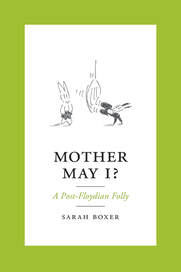
Here's the press release for my books. You can order now from Amazon & Barnes & Noble. You can also order them from my publisher, IPBooks, whose distributor is Ingram. Here is the link for In the Floyd Archives and here's the link for Mother May I?
